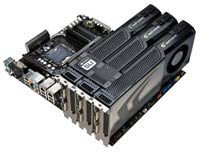
Usually Dynamic Painting requires very powerful graphic processing unit.
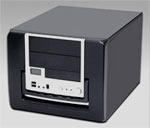
The simplest system unit is sized approx. 12" x 12" x 8", and it
is connected to the monitor with a cable up to 25' long.
|
Technology
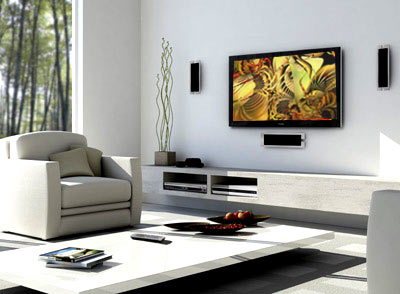
As a matter of fact the dynamic picture is an electronic device. It
consists of a flat LCD monitor sized 42" to 65" connected to a
modest size computer system unit.
HDTV LCD or a Plasma TV can serve as the monitor, provided, it features
the native video resolution 1920x1080, as well as it is equipped with a
DVI or HDMI input.
|
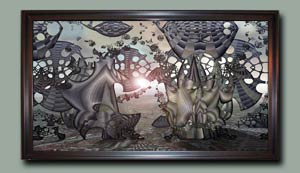
Custom made framed LCD panel 1920x1080 up to 65"
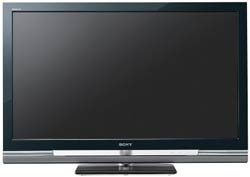
A conventional TV set complying with the said technical parameters can
also be used to display the dynamic picture. In this case a customer
toggles TV or dynamic picture with a usual remote control.
|
The dynamic pictures are great examples of the generative art taken to the next level. Since the early
days of computer history, software developers have tried to "teach" computers to
generate poetry, images, music and other forms of art. None of the previous
attempts have been really successful. Majority of the work in this area was done
by the programmers, not the professional artists, and hence many of those
efforts can hardly be called art. Also, for a long time personal computers
haven't been powerful enough to automatically generate images in real-time that
would rival the conventional paintings.
The technology used in dynamic pictures has been developed by San Base - an
artist at heart, with a great passion for both the programming and visual arts.
Basing his work on techniques used in conventional paintings, he has been able
to translate brush strokes into algorithms that can precisely convey his
original design of a digital painting. Each picture starts with an idea
described in a precise mathematical way that governs the shape, color as well as
many other parameters of the generated image. This algorithm represents a "DNA"
of the picture. Just like a DNA of a living organism, with a slight mutation,
the image algorithm can produce an infinite number of unique paintings. Yet,
each of those distinct images will follow the style and concept of the original
painting.
After a great deal of effort that goes into devising algorithms or formulas
of a picture, an artist relies on powerful computers to generate images and
mutate them over time. Many of the modern CPUs are still not powerful enough to
generate these images in real-time and only the latest developments in
programmable video cards (GPUs) have made this technology possible. Instead of
using video cards for rendering 3D images like video games do, our dynamic pictures
tap into the video card's raw compute power. Painting algorithms, translated
into shaders - programs used by GPUs - painstakingly construct painting pixel by
pixel at any desired resolution with an unprecedented level of details. Because
of this, the application of our technology is much wider than just screensavers
running at desktop resolution. We are able to produce 80-100 Mpixel paintings
for printing or the real canvas. Please visit San Base
gallery if would like to acquire any of our unique paintings on the
canvas.
Our technology, dubbed "art of the 21st century" by many professional
painters, starts a new trend in visual arts and design. We welcome you to the
21st century!
|
|
